AI-powered customer service at hotels is no longer a question of if or when. AI agents are already handling routine questions and requests across channels automatically, giving guests faster service while freeing hotel teams to focus on what matters most.
In this article, we’ll look at how hotels are putting AI customer service agents into practice. These case studies show specific ways properties are using AI to streamline guest communication, reduce repetitive work and give staff more time for the moments where a human touch matters most.
Key Highlights:
An AI customer service agent for hotels is software that automatically answers guest questions, requests and messages across text, chat and voice — with context.
Hotel AI customer service agents case studies show AI cutting front desk response times and automating most routine guest messages, freeing staff to focus on the guests in front of them.
Canary's AI customer service agents handle guest messaging, mobile check-in and upsells — all in one hospitality management platform.
What Is an AI Customer Service Agent for Hotels?
An AI customer service agent for hotels is an AI-powered system that interprets guest requests and manages the next step in the interaction. It works across hotel communication channels to understand what a guest needs and responds in a way that moves the request forward.
Unlike a scripted IVR or basic FAQ bot, an AI agent doesn’t read from a script; it understands intent, matching guests to a unique response rather than a fixed menu of options. Based on its training and the conversation, it can take action: confirming a reservation, logging a request or escalating a complaint to a staff member.
Why Are Hotels Investing in AI Customer Service?
Hotel teams are caught between rising expectations for faster, more personalized service and staff turnover that remains 76% higher than pre-2020. Add in the routine questions about check-in times, amenities and directions that cut short the interactions every GM wants to turn into genuine connections, and the pressure only builds.
The goal is to strike the right balance between automation and real-life engagement, much like designing a restaurant’s layout for a smooth service flow. AI customer service agents help hotels meet the “always available” expectation, while reducing the burden on lean teams.
Hotels are adopting AI customer service to:
Automate repetitive questions: AI handles high-volume requests about check-in times, pool hours and airport transportation without staff intervention.
Deliver 24/7 service: Guests get instant, personalized responses across text, webchat, email and phone, even outside front desk hours.
Address staffing pressure: By taking repetitive interactions off staff members’ plates, AI frees teams to focus on complex requests and in-person hospitality.
Keep up with adoption: 92% of hoteliers have adopted or plan to adopt AI guest messaging tools, making guest communication one of the most widely adopted AI use cases in hospitality.
Improve the guest experience: Among hotels that have adopted AI, 62% report improved guest satisfaction and service and 64% report time savings for staff.
Hotel AI Customer Service Case Studies: 4 Success Stories
The best way to understand AI’s impact is to see how hotels use it in everyday operations. These Canary case studies show how different types of properties are applying AI: to improve guest communication, streamline service and return valuable time to staff.
From individual hotels to multi-property portfolios, the results show that hospitality-specific AI can support better guest experiences and more efficient operations.
1. Holiday Inn Express & Suites at Orlando's SeaWorld
Holiday Inn Express & Suites at Orlando's SeaWorld used Canary to make guest communication faster and more responsive. Within four months, the hotel automated 82% of guest communication, saw a monthly lift in upsell revenue and improved its guest service score.
General Manager Mason described the shift as opening a direct line of communication, built around a guest preference for messaging. The results show that automating routine guest interactions can do more than save staff time — it can also create new revenue and strengthen the guest experience.
At The LINE SF, Canary Guest Messaging cut the hotel's response time in day-to-day guest communication from 10 minutes to 1 — a meaningful gain for guest satisfaction. Paired with mobile check-in and upsells, the hotel opened a new revenue stream overnight: 65% of early check-in revenue now comes from AI-powered upsells.
Rather than manually handling every routine question, the team leaned into guests’ growing preference for texting by using Canary as the platform to stay in touch with their guests.
Linchris Hotels shows what AI-powered guest engagement looks like at scale across a multi-property portfolio. Canary helped properties streamline the guest journey, cutting check-in time from several minutes to about one. Properties also gained the ability to independently promote last-minute offers; one message alone generated $15K in stays on an otherwise underperforming night.
Beyond the revenue gains, one property climbed from third to first place on TripAdvisor in a single season. The results show how operational improvements can extend beyond staff efficiency to shape the overall guest experience, and, according to the team, employee satisfaction.
Trapp Family Lodge and Resort offers a different perspective: how a boutique, luxury property can adopt technology while preserving the service that defines its brand. With a 30% reduction in call volume and AI natural enough that guests often believe they are speaking with staff, the property hasn’t lost its personal touch. Now, staff have the bandwidth to offer more personalized service.
The case study shows how AI can take repetitive work off staff members' plates while preserving the human connection at the heart of the guest experience.
What Can Hoteliers Learn from These AI Customer Service Case Studies?
Across different property types and operating models, the same pattern emerges: AI delivers the most value when it is woven into a hotel’s existing operations. Rather than acting as a standalone tool, AI connects guest communication, check-in and revenue opportunities into workflows tailored to each property.
Takeaway #1: Connect AI to the Hotel Systems You Already Use
AI works best when it has the context and connectivity to take action. These case studies show the power of pairing AI with existing guest data targeting the right guests with last-minute offers, or saving the team from manually pulling guest context just to respond to a message.
Integrations turn AI from a communication tool into an operational layer that runs things for you. Responding to a guest, surfacing an upsell or moving a request through the right workflow without staff needing to bridge the gaps manually. Integration is also one of the biggest challenges hoteliers face when implementing AI with 40% of hoteliers citing integration as a key barrier to implementation.
Takeaway #2: Guest Response-Time Gains Show up at Any Property Size
The benefits of faster service aren't limited to big technology budgets. Across these case studies, AI improved response times in very different operating environments, from a boutique lodge to a multi-property portfolio. A guest messaging at 10 a.m. for a late checkout will make other plans if they don’t hear back before official checkout time, regardless of property size.
That makes response speed less about property size and more about how effectively AI handles routine guest interactions. When common requests get an immediate response, every guest is taken care of with no communication backlog.
Takeaway #3: Hotel Staff Time Saved Converts into Revenue, Not Just Cost Savings
The value of AI isn't simply measured by how many staff hours it saves. Those hours create opportunities for hotels to drive additional revenue through loyalty, upsells and various other forms of engagement. For example, when a team member is free to serve a welcome drink, the guest may order food from the bar and linger longer. The use of this “freed up” time transforms into an upsell, an engagement with the product and a great way to start a stay. Canary's research reinforces this connection: 64% of hoteliers that have adopted AI report staff time savings, while hotels also report increases in room revenue and ancillary revenue.
The four case studies show how hotels of different sizes and types are using Canary to improve guest communication, streamline operations and create new revenue opportunities.
Hotel AI Customer Service Agents Case Study
Solutions Used
Key Impact
Holiday Inn Express & Suites at Orlando's SeaWorld
Guest Messaging, Upsells
Faster guest response times, increased monthly upsell revenue and improved guest service scores
The LINE SF
AI Guest Messaging
High guest adoption and significant staff time reclaimed from repetitive requests
Linchris Hotels
Guest Messaging, Mobile Check-In
Check-in time reduced from several minutes to about one minute, with a Tripadvisor ranking increase at one property
Trapp Family Lodge and Resort
Guest Messaging, Upsells
Streamlined guest communication and greater staff efficiency while maintaining personalized service
Why AI Customer Service Improves Hotel Guest Experience
When AI customer service is used to complement — not replace — front desk teams, it improves the hotel guest experience by making communication faster, more responsive and consistent, while enabling teams in the process. Guests can get immediate answers and support 24/7, while AI delivers the same accurate information regardless of shift, channel or language. That combination of responsiveness and staff presence is what ultimately drives the guest experience.
What Should Hotels Look for in an AI Customer Service Platform?
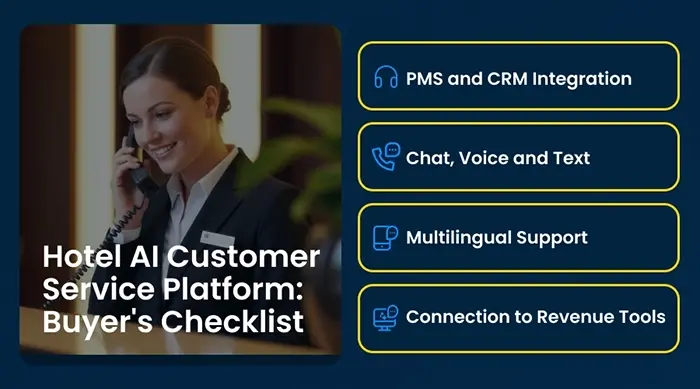
A recent study by Harvard Business School found that incorporating AI assistance into customer interactions reduces response times by up to 22% overall — and by as much as 70% for frontline staff — while significantly boosting overall customer sentiment. But choosing the right system goes beyond finding a basic chatbot. Use this buyer’s checklist to evaluate whether a platform can integrate smoothly into your hotel’s daily operations, deliver consistent service across every guest touchpoint, and unlock new revenue.
PMS and CRM Integration
A disconnected AI tool can create more manual work than it saves if staff still have to look up guest details to feed it, or update hotel systems themselves after every interaction. PMS and CRM integration gives AI the context it needs to deliver more personalized responses and helps move requests through existing workflows without creating another system for staff to manage.
Channel Coverage: Chat, Voice and Text
Guests communicate with hotels through the channels they already use, so relying on a single channel can leave important gaps in the guest journey. A platform that supports chat, voice and SMS can help hotels provide a more consistent experience whether a guest sends a message, calls the hotel or needs assistance through webchat.
Multilingual Support
Hotels serve guests from around the world, making multilingual communication a baseline requirement for modern guest service. AI customer service should help teams to easily communicate with international guests in their preferred language without requiring staff to provide around-the-clock language coverage.
Connection to Revenue Tools
A tool is only as good as the information it can source. When hotel AI connects directly to upsells and upgrades, every guest interaction can also become an opportunity to generate incremental revenue — while an isolated customer service tool leaves that revenue lever unused. A guest asking about checkout or housekeeping, for instance, can just as easily be prompted to tip staff or add a room upgrade — turning routine service touchpoints into revenue moments instead of missed ones.
Bring AI Customer Service Agents to Your Hotel with Canary
Going all-in on AI isn’t a leap of faith but a strategic move. The hotel AI customer service agents case studies above show what’s possible when AI is built around the way hotels actually operate. Canary AI is purpose-built for hospitality, helping hotels automate guest communication, support staff and connect guest interactions to operational and revenue workflows.
Key Canary AI features include:
AI Guest Messaging: Automate more than 80% of guest inquiries and provide instant responses.
AI Voice: Handle front desk and call center inquiries, reservations, FAQs and more.
AI Webchat: Answer questions on your hotel website and help turn website visits into direct bookings.
100+ languages: Communicate with guests in their preferred language through automatic translation.
Automated service tickets: Turn guest messages into service tickets and route them to the appropriate team.
Revenue opportunities: Identify guest needs and surface relevant upsells at the right moment.
Human handoffs: Automatically route inquiries to hotel staff when AI needs assistance.
Ready to see how AI customer service can work at your property?Book a Canary demo and see the platform in action.
Frequently Asked Questions
Can AI Replace Hotel Front Desk Clerks?
No. AI can handle high volumes of routine guest interactions, but it doesn’t replace the human judgment and empathy hotel staff bring to complex situations. The strongest approach is to let AI manage repetitive requests and route complaints, VIP needs and emotionally charged interactions to staff who can provide a personal response.
Hotel Guest Requests AI Customer Service Handles
What Still Needs Hotel Staff
FAQs about check-in times, amenities and hotel policies
Complaints that require empathy, judgment or service recovery
Routine requests, such as directions, transportation and amenity information
VIP requests and highly personalized guest needs
Common guest messages and questions across channels
Emotionally charged situations or requests that require human discretion
Can AI Improve Hotel Customer Service?
Yes. AI can improve hotel customer service by providing faster responses, handling routine requests 24/7 and giving staff more time to focus on complex or high-value guest interactions. The key is using AI to augment hotel teams as additional support — not replace the human service guests still expect from your team.
Can AI Effectively Automate Pre-Stay Guest Communication?
Yes. AI can automate many pre-stay interactions, including answering common questions, sharing property information, confirming details and responding to guest requests before arrival. This gives guests timely support while reducing repetitive communication work for hotel staff.
Can I Integrate AI Front Desk with an Existing Hotel CRM System?
Yes. Integration capabilities should be a key consideration when evaluating an AI customer service platform. Connecting AI with existing front desk software, PMS and CRM systems gives it the guest and reservation context needed to provide more personalized service without creating additional manual work for staff.
How Much Does AI Customer Service Cost for Hotels?
AI customer service costs vary based on the platform, property size, channels supported and level of automation. Hotels should evaluate the cost alongside potential savings from reduced manual work and opportunities to generate additional revenue through automated upsells and upgrades.
Is Guest Data Secure with AI-Powered Customer Service?
Guest data security should be a core requirement when selecting an AI customer service platform. Hotels should evaluate how a provider handles guest information, data access, integrations and security controls before deploying AI across guest communications.